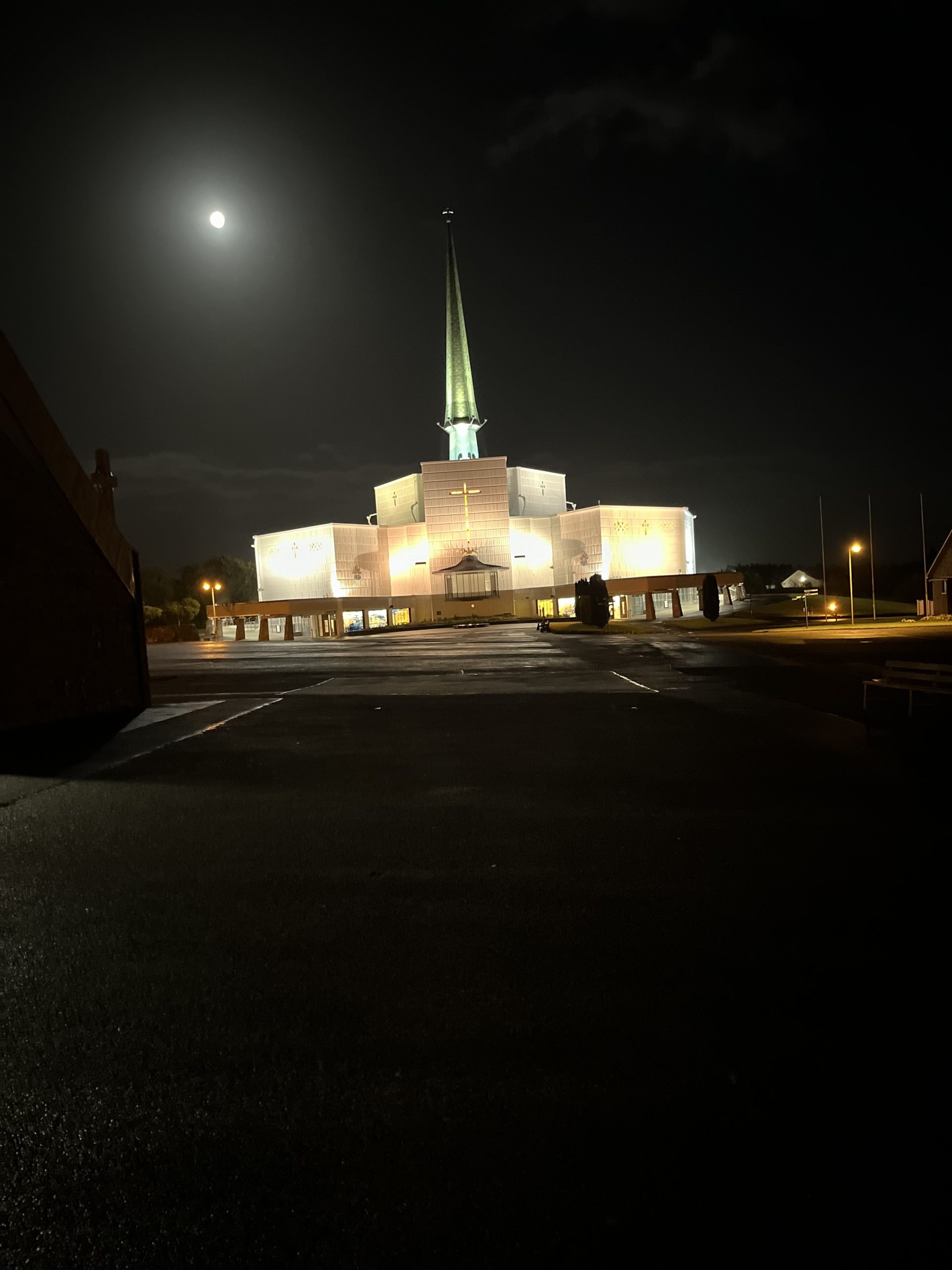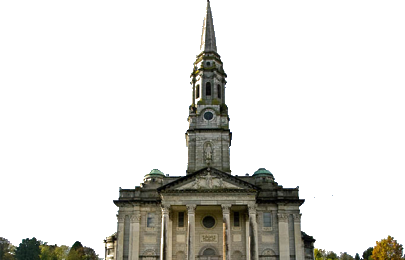
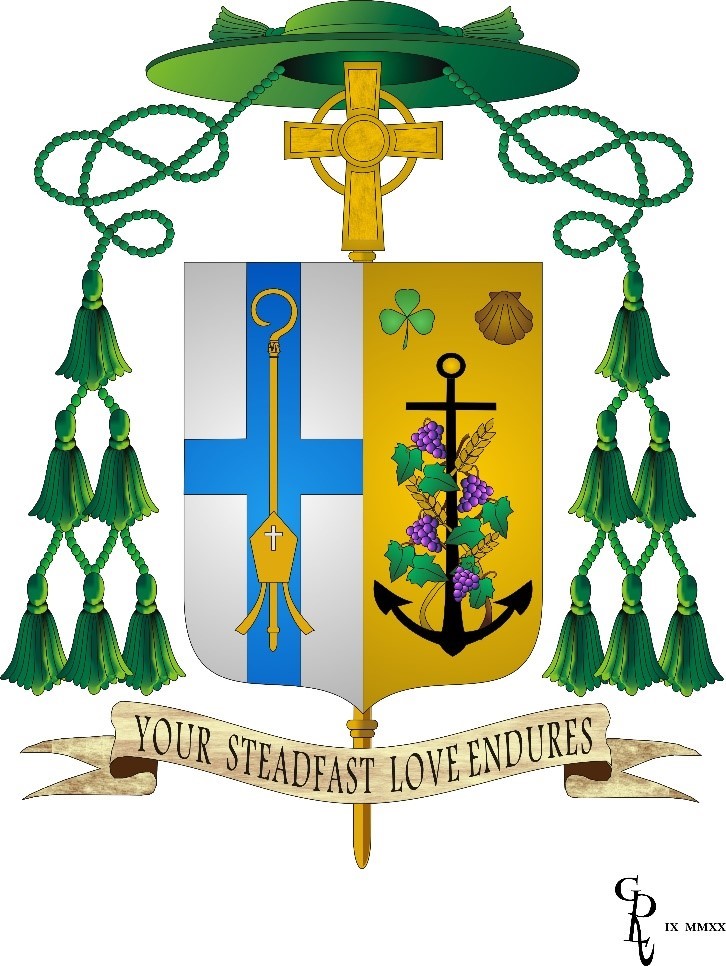
BISHOP MARTIN HAYES’ HOMILY DURING MASS AT THE KILMORE DIOCESAN PILGRIMAGE TO KNOCK, IRELAND’S INTERNATIONAL EUCHARISTIC AND MARIAN SHRINE – BASILICA OF OUR LADY OF KNOCK – SATURDAY 8 AUGUST 2026
Our Gospel just proclaimed describing the scene of Mary and John the Apostle at the Cross, is depicted in a series of paintings known as the Stabat Mater, a phrase which means ‘the sorrowful mother was standing’. The notable original masterpieces are by Rogier van der Weyden and by Hendrick ter Brugghen.
The Stabat Mater paintings express both absolute grief and daring hope for the future. They symbolise the birth of the Church based on the spiritual bond between Mary and John. Jesus entrusts John to Mary with the words, “Woman, this is your son” and says to John, “This is your mother”. It was Mary, the mother of Jesus and John the Beloved Disciple who stood by Jesus at this Crucifixion. Now Mary is given responsibility for the Beloved Disciple who represents the community of believers receiving Mary as a spiritual mother. Mary is both Mother of Jesus Christ and is our Mother. Of course, both Mary and John the Apostle and Evangelist appeared here at Knock just about 147 years ago with St Joseph and with a symbolisation of the Eucharist as depicted above me in this Basilica, Ireland’s International Eucharistic and Marian Shrine which has just celebrated its 50th anniversary.
The depiction of the Stabat Mater inspired by our Gospel today teaches us that amid chaos there is hope and the real possibility of new life through faith in Jesus who was sent among us by God, our Father. The Word of God, in our first reading from the prophet Isaiah is calling us to new insights, a new vision, a new spirit, a new energy, and to just keep on going. We are in a time of being a smaller Church, of smaller congregations in our churches and so we are being called to go deeper and to reflect prayerfully on the scriptures, the Word of God, to fully grasp its relevance for our time. The Word of God offers us the inspiration to keep going. We are grateful that when the fullness of time had come (Second Reading from Galatians) God sent his Son Jesus among us. The promises proclaimed in the Old Testament scriptures were fulfilled and our Gospel of today communicates that the mission of Jesus has been entrusted to the Church represented by Mary and John – the baton has been handed on to us!
As I have already stated, the Stabat Mater series of paintings depict a moment of crisis and hope for the future, the birth of something new, the Church, of starting out again. We must begin again, in the words of the poet, Brendan Kennelly, “something that will not acknowledge conclusion, insists that we forever begin”. As Church, as Church in Ireland, in the Diocese of Kilmore we are must constantly begin again in different ways. We begin again with our priests of Kilmore who take up new appointments on 17th August in an ever more challenging mission. Our candidates for pastoral ministry begin again their formation in this coming September. The pastoral and educational year begins again in our parishes and schools in September. We give thanks for the commitment of all involved in ministry, our lay people, deacons and priests on a mission which is ever more challenging and thereby invigorating today.
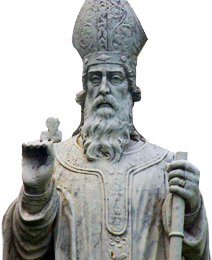
We can draw inspiration from St Dominic, whose Memorial we celebrate today and whose motto is “to praise, to bless, to preach”. St Dominic reminds us to acknowledge and give thanks to God our Creator, to affirm and bless each other as we are each made in the image of God and to preach with our good example and actions. We are called to constantly begin again, that is, “Begin to the loneliness that cannot end” according to Brendan Kennelly.
In order to begin again, we must be open to the mystery of the Cross of Jesus Christ, of dying and rising again, of finding new life amid change and seeming chaos. It is more important that we gather on Sundays, to hear again the story of faith as proclaimed in the scriptures and to receive of the Eucharist, the Body of Jesus Christ, to bond as communities of faith and be ready to give witness to our Christian faith in the world today. Our Patron Saint in Kilmore Diocese is St Felim who lived in the 6th Century in Breifne. We know little of him, or of his writings, only that he was a hermit, a person of prayer. His legacy is that invitation to us to take time for prayer. His memory and feast day were preserved by the O’Reilly clan, albeit arising from their rivalry with neighbouring clans, during the early 17th Century. However, the memory of St Felim remains, and tomorrow, Sunday, we celebrate St Felim as a Feast in Kilmore Diocese.
Returning to the scriptures of today, I am taken by the phrase in our second reading from St Paul to the Galatians when the fullness of time had come which points to the birth of Jesus Christ to Mary, our Mother. His birth was the fulfilment of the promise of God, our Father. Indeed, again in the fullness of time, with those words of Jesus to his Mother and to John from the Cross, the Church was born out of the tragedy of the Crucifixion. It is a theme that is often repeated in the subsequent history of our Church; we can recall the uplifting impact of Apparitions here in Knock after the tragedy of the Great Famine and the turmoil of the Land Wars and economic distress. In our time, in this fullness of time, we are called despite the challenges of global unrest and constant opposition to continue to rely on God, the nourishment of Jesus in the Eucharist, the inspiration of the Holy Spirit and the guidance of our Mother Mary.
Each year brings new challenges and while we are not getting any younger, we look to the future, to our young people. We yearn to leave our legacy, our mark, to do what we can with God’s help. In preparing for the Silver Jubilee celebrations of three Missionary Sisters of the Holy Rosary in Kilmore which will take place in Cavan on October 3rd, I heard of how their faith had its roots in the witness of missionaries from Germany, Britian, and Ireland. While many of these missionaries were deported, or have gone hopefully to their eternal reward, they have had a significant influence on the vocational commitment of the Sisters who now celebrate their Silver Jubilees among us. We begin again, again.
As God, Our Father, sent Jesus among us in the fullness of time, as Jesus entrusted the birth of the Church to Mary and John, as we receive our mission as Church today as children of God, may we be open to God who has sent the Spirit of his Son into our hearts as proclaimed by St Paul in our second reading. May we cry our Abba! Father! acknowledging God as our Father, be guided by Mary, Our Mother and inspired by St John. With their help, the Stabat Mater teaches us to rise beyond our sorrow and sadness to new life, to begin again.