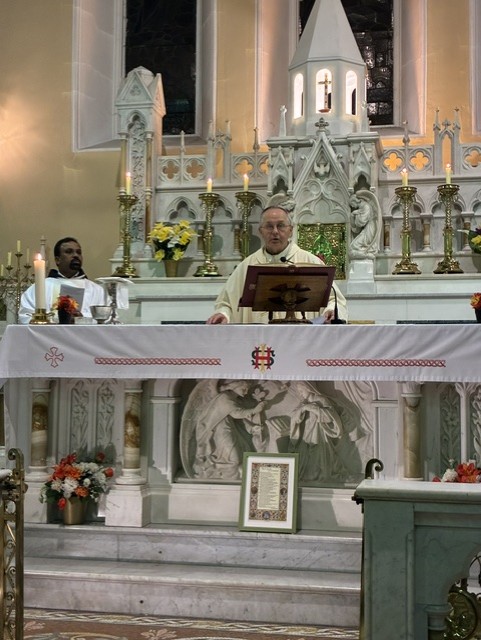
There was a large attendance at a special Mass in St Clare’s Chapel in Cavan on Thursday 29 October last marking the 800th anniversary of the death of St Francis of Assisi and the contribution made by the Franciscan tradition to the life of the Diocese of Kilmore.
Bishop Martin Hayes was the principal celebrant of the Mass assisted by Monsignor Liam Kelly, PP VG, Ballyconnell: Fr Ultan McGoohan, Adm. Cavan; Fr Liam Kelly OFM (representing Fr David Collins OFM, Irish Minister Provincial); Fr Seán Kelly OFM Cap. (Knock Shrine); Fr Kieran Cronin OFM (Guardian of Multyfarnham Abbey); Fr James Connolly OFM Cap. (Church Street, Dublin): Fr Anthony Joy OFM Cap. (Raheny); Fr Gerard Cassidy PP Ballyhaise; Fr Martin Gilcreest PP Laragh; Fr Patrick Ezefunamba, CC Cavan; and Fr Matthew Alechenu Onyilo, CC Cavan.
Afterwards, Monsignor Liam Kelly gave a very interesting and informative talk to a very large audience in The Farnham Arms Hotel in Cavan during which he explored the historic relationship between the Franciscan Order and the Diocese of Kilmore.
The text of Bishop Martin’s homily is given below:
As we celebrate the 800th Anniversary of St Francis of Assisi we are conscious that he chose poverty over riches, and to remain on the margins of Church and society. He had a mission to rebuild the Church and so he went to San Damiano on the edge of Assisi to repair the church building, thereby symbolising his new Way.
In the spirit of our Gospel, of the disciples being ‘sent out in pairs carrying no money bags, no sacks, no sandals’, I am reminded of the statues of St Francis and his Companions erected in Rome 100 years ago at the Piazza di Porta San Giovanni. They are located between the Basilica of the Holy Cross of Jerusalem and the Basilica of John Lateran. The sculptor, Giuseppe Tonnini, depicts St Francis with arms outstretched to embrace the Church represented by the Basilica of John Lateran, the Cathedral Church of Rome. St Francis had arrived in Rome to seek approval for his Way of life and that of his companions from Pope Innocent III, who gave him due recognition.
The statues of St Francis and his Companions are situated on a base of porous volcanic stone made up of grains of sand. There is a frailty about Francis which we celebrate in the Franciscan Way and to which we are indebted here in Ireland. The Franciscan Way suggests that the recognition of our frailty is and will be the making of us. That venturing out into the unknown, of challenging that which is established and perhaps dying is a calling that is inspired by the bestowal of the Spirit of the Lord God upon us as proclaimed in our first reading from Isaiah. The divinely inspired Way of St Francis and St Clare provided an impetus that brought and brings good news to the poor, the lonely, the broken, the captive, the prisoner and to those who are grieving.
That influence of God, ‘the favours of the Lord’ as proclaimed in our responsorial psalm are evident, as well, in the phrase, ‘My kindness is established forever’ and in the reference to the way God’s hand holds David. It is the same ‘loving kindness of the heart of our God’ that is celebrated by Zechariah in the prayer of the Benedictus. Eventually, that ‘loving kindness’ was to be celebrated in the birth of Jesus, the event of Christmas, which was given particular emphasis by St Francis with his focus on prayer with the Crib. Pope Francis, of course, inspired by St Francis, invited us to be alert to the ‘tender kindness’, the tenderness of God reaching out to us.
We gather this evening on this the 800th Anniversary of the death of St Francis to give thanks for the influence of the Franciscans in Kilmore Diocese. Msgr. Liam will later provide the precise detail of their actual impact especially during difficult times. The significant sites of Franciscan activity for us are St Mary’s in Cavan, Creevelea, in Co Leitrim and Multyfarnham situated in Co Westmeath, outside of Kilmore Diocese. It is important that we also celebrate the influence of St Clare, the spiritual companion of St Francis, in Cavan, Ballyjamesduff and that of St Francis in Rossinver.
In tough times, during the suppression of churches, monasteries, friaries, the Franciscans came into their own here in Kilmore. The Friary in Cavan despite fire, destruction, later occupation by military forces, provided learning, leadership and the friars had an influence on civic matters with the support of the O’Reilly clan. On being thrown out of their friary, the Franciscans occupied thatched cabins nearby to continue nurturing the faith of the people and being of practical assistance to the poor.
Over in Creevelea, the friars with the support of the O’Rourke’s survived much of suppression of the Tudors, fire and destruction, and they too took up residence beyond the friary to foster the faith in the local area. Msgr. Liam records in ‘The Diocese of Kilmore c1100-1800’ that they were ‘living in dangerous times’. Conn O’Rourke and Patrick O’Healy, two notable friars on their return to Ireland, had been executed. The friars at Creevelea had a tower built which had a secret hiding place and again when they had to leave, they scattered to live in thatched cabins in the neighbourhood to continue their pastoral mission. We recall people like Blessed Charles Meehan, a Franciscan, from nearby Ballaghameehan, who was martyred in Penal Law times for our Christian faith as he attempted to return to Ireland via Wales. In the spirt of our Gospel this evening we see that the Franciscans were like lambs among wolves.
Then there was and there is Multyfarnham Friary, which was also subject to fire and attack and was a resource for a mission to Kilmore Diocese. Notably, Richard Brady, friar and Bishop of Kilmore for 27 years exercised his pastoral ministry from Multyfarnham despite ongoing persecution. We give thanks for the presence of the Friars in nearby Multyfarnham today.
The Sisters of St Clare came to this diocese on May 28th 1861. St Joseph Abbey was founded in Cavan, as well as a school to work with children. In addition to the usual subjects, the Sisters taught vocal and instrumental music, drawing and needlework. An orphanage was opened in 1865, where tragically, in 1943 a disastrous fire destroyed the Orphanage. The Sisters of St Clare continue each year to remember the children and one adult who died. A new Primary school building was opened in 1970 and has recently been extended. A Post Primary school flourished until 1975. Thankfully, the Sisters of St Clare continue to have a presence in Cavan through their support of the Travelling people and in their ministry with St Vincent de Paul.
The 6th of February 1872 saw the arrival of the first members of the new community of St Clare Sisters in Ballyjamesduff and in 1883 they built their convent, opened a primary school in 1956, a secondary school a year later and the ethos of St Clare continues to be celebrated in both schools.
The Franciscan Sisters of the Atonement moved into their new convent in Rossinver on May 15th, 1935. During the years that followed thirty-nine Leitrim nuns joined in Rossinver, ten of those coming from the local area, the others from many other counties in Ireland. Tributes continue to be paid, and thanksgiving offered for the contribution of Franciscan Sisters of the Atonement, locally.
As will be illustrated in detail later by Msgr. Liam later, we can be grateful to the friars and the sisters inspired by St Francis and St Clare who made a most significant contribution to the faith of the people of Kilmore Diocese.
We continue to draw inspiration from St Francis, as the Patron of Ecology as Pope Francis did in his writing of Laudato Si’. Indeed, the title, Laudato Si’ is of the Canticle of Creatures of St Francis. It means that the spirituality of St Francis is even more relevant in our world today which is amid a climate crisis. We give thanks for the beauty and diversity of creation, for our raising awareness of the causes of the current climate crisis and our efforts to address them.
Finally, we give thanks for St Francis and as a diocese we look forward to going on pilgrimage to Assisi next month. We will once again imbibe the spirits of St Francis and St Clare to guide us in our mission inspired by the loving kindness of the heart of our God.